| {{customText[An overview of the clinical trials and dosing of an STR|Details about a triple therapy STR]}}
|
| |

|
|
| |
|
|
|
|
| |
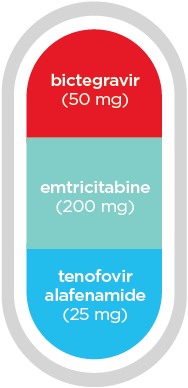
BIKTARVY® combines the DESCOVY® (FTC/TAF)* backbone with bictegravir, a novel and unboosted INSTI, for a powerful STR.1,2
|
|
|
|
|
| INDICATIONS |
BIKTARVY is indicated as a complete regimen for the treatment of HIV-1 infection in adult and pediatric patients weighing ≥25 kg who have no antiretroviral (ARV) treatment history or to replace the current ARV regimen in those who are virologically suppressed (HIV-1 RNA <50 copies per mL) on a stable ARV regimen with no history of treatment failure and no known resistance to any component of BIKTARVY.
DESCOVY, a component of BIKTARVY, is indicated in combination with other antiretroviral (ARV) agents for the treatment of HIV-1 infection in patients weighing at least 35 kg.
|
|
|
| |
| IMPORTANT SAFETY INFORMATION FOR BIKTARVY AND DESCOVY |
| BOXED WARNING: POST TREATMENT ACUTE EXACERBATION OF HEPATITIS B |
 |
Severe acute exacerbations of hepatitis B have been reported in patients who are coinfected with HIV-1 and HBV and have discontinued products containing emtricitabine (FTC) and/or tenofovir disoproxil fumarate (TDF), and may occur with discontinuation of BIKTARVY or DESCOVY. Closely monitor hepatic function with both clinical and laboratory follow-up for at least several months in patients who are coinfected with HIV-1 and HBV and discontinue BIKTARVY or DESCOVY. If appropriate, anti-hepatitis B therapy may be warranted. |
Please see below for additional Important Safety Information for BIKTARVY and DESCOVY.
|
|
| Dear {{customText[Dr.|Mr.|Mrs.|Ms.|]}} {{accFname}} {{accLname}}, {{customText[MD,|DO,|PharmD,|PA,|NP,|]}} |
{{customText[I'm excited to have a discussion with you about a triple therapy STR with a novel and unboosted INSTI.|I'm looking forward to providing a more detailed look at a triple therapy.|I'd like to discuss BIKTARVY and what makes this treatment different.|It was great catching up with you.|Thanks for taking the time to meet with me.|Glad we had a chance to talk about BIKTARVY.|Hoping to schedule some time to meet with you.|Would love to connect about BIKTARVY—a triple therapy STR with a novel and unboosted INSTI from Gilead Sciences.|I would like to take this opportunity to introduce myself.]}}
{{customText[Below you will find some information about BIKTARVY that may be of interest.|Here is some information about BIKTARVY ahead of our meeting.|To get started, I have provided some materials on the clinical trials and dosing of BIKTARVY.|I'm writing to follow up on what we discussed. Below are some highlights of our conversation.|As a continuation of our discussion, I would like to share details about the clinical trials and dosing of BIKTARVY.|To further our conversation, I would like to provide some additional details about BIKTARVY that may interest you.|I have included some information about BIKTARVY that I think will be relevant to your practice.|I'm eager to share some information about the clinical trials of BIKTARVY and its dosing.|Since we haven't had a chance to meet yet, I would like to share some information about BIKTARVY, a triple therapy STR from Gilead Sciences.]}}
Please click to view full Prescribing Information for BIKTARVY and DESCOVY, including BOXED WARNINGS.
|
| IMPORTANT SAFETY INFORMATION FOR BIKTARVY AND DESCOVY (cont’d) |
| Contraindications |
| Contraindications for BIKTARVY: |
|
|
Coadministration: Do not use BIKTARVY with dofetilide or rifampin.
|
|
 |
DHHS RECOMMENDED
AS AN
INITIAL REGIMEN FOR MOST PEOPLE WITH HIV-13
|
|
BIKTARVY Is Backed by
Robust Clinical Trial Experience1,4 |
| |
| Extensive clinical trials with over 1500 people including various age groups and ethnicities |
| |
|
Treatment-Naïve Adults
|

|
|
STUDY 1489
BIKTARVY (n=314)
vs
ABC/DTG/3TC
(n=315)
|
 |
STUDY 1490
BIKTARVY (n=320)
vs
FTC/TAF+DTG
(n=325)
|
| |
| Virologically Suppressed Adults |
| |
|
|
|
STUDY 1844
Switched to BIKTARVY
(n=282) or continued
on ABC/DTG/3TC
(n=281)
|
|
STUDY 1878
Switched to BIKTARVY
(n=290) or stayed on
baseline regimen†
(n=287)
|
|
| |
| †ABC/3TC or FTC/TDF + boosted ATV or DRV regimen (cobicistat or ritonavir). |
| |
| Virologically Suppressed Adult Women |
| |
|
|
|
STUDY 1961
Switched to BIKTARVY (n=234) or
stayed on baseline regimen‡
(n=236) |
|
| |
| ‡E/C/F/TAF or E/C/F/TDF or ATV+RTV+FTC/TDF. |
| |
| Virologically Suppressed Pediatric Patients |
| |
|
|
|
STUDY 1474
Switched to BIKTARVY (n=100)§ |
|
|
| § |
Open-label, single-arm trial included virologically suppressed adolescents, ages 12 to less than 18 years weighing at least 35 kg (n=50) and virologically suppressed children, ages 6 to less than 12 years weighing at least 25 kg (n=50). |
|
|
IMPORTANT SAFETY INFORMATION FOR BIKTARVY AND DESCOVY (cont’d) |
| Warnings and precautions |
| Warnings and precautions for BIKTARVY and DESCOVY: |
|
|
Immune reconstitution syndrome, including the occurrence of autoimmune disorders with variable time to onset, has been reported.
|
|
| Components Matter1-3,5,6 |
|
| BIKTARVY is a triple therapy STR that pairs the power of bictegravir with a trusted dual-NRTI backbone |
|
 |
|
| Bictegravir—a novel and unboosted INSTI |
|
|
Long plasma half-life of 17.3 hours|| |
|
|
|
Long integrase binding half-life of 38 hours in vitro¶ |
|
|
|
The clinical relevance of these data has not been established. |
|
|
 |
|
| DESCOVY—a DHHS-recommended backbone |
|
|
DESCOVY (FTC/TAF) is a dual-NRTI that can be used as a backbone in 3 DHHS-recommended initial regimens for most people with HIV |
|
|
Backed by over 1 million patient-years of experience# |
|
|
| || |
Plasma half-life: the time for the plasma concentration of bictegravir to fall to half its original value. |
| ¶ |
Integrase binding: the residence time of bictegravirr on the integrase-DNA complex. |
| # |
Estimated postmarketing exposure for all TAF-containing HIV products, cumulative to January 2019. |
|
IMPORTANT SAFETY INFORMATION FOR BIKTARVY AND DESCOVY (cont’d) |
| Warnings and precautions (cont’d) |
| Warnings and precautions for BIKTARVY and DESCOVY (cont’d): |
|
New onset or worsening renal impairment: Cases of acute renal failure and Fanconi syndrome have been reported with the use of tenofovir prodrugs. In clinical trials of emtricitabine and tenofovir alafenamide (TAF) with other ARVs, there have been no cases of Fanconi syndrome or proximal renal tubulopathy (PRT). Do not initiate in patients with estimated creatinine clearance (CrCl) <30 mL/min. Patients with impaired renal function and/or taking nephrotoxic agents (including NSAIDs) are at increased risk of renal-related adverse reactions. Discontinue in patients who develop clinically significant decreases in renal function or evidence of Fanconi syndrome.
Renal monitoring: Prior to or when initiating and during therapy, assess serum creatinine, CrCl, urine glucose, and urine protein in all patients as clinically appropriate. In patients with chronic kidney disease, assess serum phosphorus. |
|
| |
| Simple Dosing With BIKTARVY1,5 |
| |
 |
Once-Daily
STR |
|
 |
 |
Taken Any
Time of Day |
|
 |
|
|
 |
No Food
Requirement |
|
|
 |
| No Booster |
|
|
| |

Not actual size.
Actual size is 15mm x 8mm.
|
BIKTARVY combines the DESCOVY (FTC/TAF)* backbone with bictegravir, in a small and powerful unboosted STR
|
|
| |
|
BIKTARVY is not recommended in patients with severe renal impairment (estimated CrCl <30 mL/min) or severe hepatic impairment (Child-Pugh Class C) |
|
|
|
| IMPORTANT SAFETY INFORMATION FOR BIKTARVY AND DESCOVY |
| |
| BOXED WARNING: POST TREATMENT ACUTE EXACERBATION OF HEPATITIS B |
| |
|
Severe acute exacerbations of hepatitis B have been reported in patients who are coinfected with HIV-1 and HBV and have discontinued products containing emtricitabine (FTC) and/or tenofovir disoproxil fumarate (TDF), and may occur with discontinuation of BIKTARVY or DESCOVY. Closely monitor hepatic function with both clinical and laboratory follow-up for at least several months in patients who are coinfected with HIV-1 and HBV and discontinue BIKTARVY or DESCOVY. If appropriate, anti-hepatitis B therapy may be warranted. |
| |
| Contraindications |
| |
| Contraindications for BIKTARVY: |
| |
|
Coadministration: Do not use BIKTARVY with dofetilide or rifampin. |
| |
| Warnings and precautions |
| |
| Warnings and precautions for BIKTARVY and DESCOVY: |
| |
|
Immune reconstitution syndrome, including the occurrence of autoimmune disorders with variable time to onset, has been reported. |
|
New onset or worsening renal impairment: Cases of acute renal failure and Fanconi syndrome have been reported with the use of tenofovir prodrugs. In clinical trials of emtricitabine and tenofovir alafenamide (TAF) with other ARVs, there have been no cases of Fanconi syndrome or proximal renal tubulopathy (PRT). Do not initiate in patients with estimated creatinine clearance (CrCl) <30 mL/min. Patients with impaired renal function and/or taking nephrotoxic agents (including NSAIDs) are at increased risk of renal-related adverse reactions. Discontinue in patients who develop clinically significant decreases in renal function or evidence of Fanconi syndrome.
Renal monitoring: Prior to or when initiating and during therapy, assess serum creatinine, CrCl, urine glucose, and urine protein in all patients as clinically appropriate. In patients with chronic kidney disease, assess serum phosphorus. |
|
Lactic acidosis and severe hepatomegaly with steatosis: Fatal cases have been reported with the use of nucleoside analogs, including FTC and TDF. Discontinue if clinical or laboratory findings suggestive of lactic acidosis or pronounced hepatotoxicity develop, including hepatomegaly and steatosis in the absence of marked transaminase elevations. |
| |
| Additional warnings and precautions for BIKTARVY: |
| |
|
Drug interactions: See Contraindications and Drug Interactions sections. Consider the potential for drug interactions prior to and during BIKTARVY therapy and monitor for adverse reactions. |
| |
| Adverse reactions |
| |
| Adverse reactions for BIKTARVY: |
| |
|
Most common adverse reactions (incidence ≥5%; all grades) in clinical studies through week 144 were diarrhea (6%), nausea (6%), and headache (5%). |
| |
| Adverse reactions for DESCOVY: |
| |
|
Most common adverse reaction (incidence ≥10%; all grades) in clinical studies was nausea (10%). |
| |
| Drug interactions |
| |
| Drug interactions for BIKTARVY and DESCOVY: |
| |
|
Prescribing information: Consult the full prescribing information for more information on Contraindications, Warnings, and potentially significant drug interactions, including clinical comments. |
| |
|
Drugs affecting renal function: Coadministration with drugs that reduce renal function or compete for active tubular secretion may increase concentrations of FTC and tenofovir and the risk of adverse reactions. |
Please see below for additional Important Safety Information for BIKTARVY and DESCOVY. |
|
|
|
| |
| |
IMPORTANT SAFETY INFORMATION FOR BIKTARVY AND DESCOVY (cont’d) |
| |
| Warnings and precautions (cont’d) |
| Warnings and precautions for BIKTARVY and DESCOVY (cont’d): |
|
|
Lactic acidosis and severe hepatomegaly with steatosis: Fatal cases have been reported with the use of nucleoside analogs, including FTC and TDF. Discontinue if clinical or laboratory findings suggestive of lactic acidosis or pronounced hepatotoxicity develop, including hepatomegaly and steatosis in the absence of marked transaminase elevations. |
|
| Additional warnings and precautions for BIKTARVY: |
|
|
Drug interactions: See Contraindications and Drug Interactions sections. Consider the potential for drug interactions prior to and during BIKTARVY therapy and monitor for adverse reactions. |
| Adverse reactions |
| Adverse reactions for BIKTARVY: |
|
|
Most common adverse reactions (incidence ≥5%; all grades) in clinical studies through week 144 were diarrhea (6%), nausea (6%), and headache (5%). |
|
| Adverse reactions for DESCOVY: |
|
|
Most common adverse reaction (incidence ≥10%; all grades) in clinical studies was nausea (10%). |
| Drug interactions |
| Drug interactions for BIKTARVY and DESCOVY: |
|
Prescribing information: Consult the full prescribing information for more information on Contraindications, Warnings, and potentially significant drug interactions, including clinical comments. |
|
Drugs affecting renal function: Coadministration with drugs that reduce renal function or compete for active tubular secretion may increase concentrations of FTC and tenofovir and the risk of adverse reactions. |
| Additional drug interactions for BIKTARVY: |
|
Enzymes/transporters: Drugs that induce P-gp or induce both CYP3A and UGT1A1 can substantially decrease the concentration of components of BIKTARVY. Drugs that inhibit P-gp, BCRP, or inhibit both CYP3A and UGT1A1 may significantly increase the concentrations of components of BIKTARVY. BIKTARVY can increase the concentration of drugs that are substrates of OCT2 or MATE1. |
| Additional drug interactions for DESCOVY: |
|
Metabolism: Drugs that inhibit P-gp can increase the concentrations of components of DESCOVY. Drugs that induce P-gp can decrease the concentrations of components of DESCOVY, which may lead to loss of efficacy and development of resistance. |
|
| Drug interactions (cont’d) |
| |
| Additional drug interactions for BIKTARVY: |
| |
|
Enzymes/transporters: Drugs that induce P-gp or induce both CYP3A and UGT1A1 can substantially decrease the concentration of components of BIKTARVY. Drugs that inhibit P-gp, BCRP, or inhibit both CYP3A and UGT1A1 may significantly increase the concentrations of components of BIKTARVY. BIKTARVY can increase the concentration of drugs that are substrates of OCT2 or MATE1. |
| |
| Additional drug interactions for DESCOVY: |
| |
|
Metabolism: Drugs that inhibit P-gp can increase the concentrations of components of DESCOVY. Drugs that induce P-gp can decrease the concentrations of components of DESCOVY, which may lead to loss of efficacy and development of resistance. |
|
| |
| Dosage and administration |
| |
| Information for BIKTARVY: |
| |
|
Dosage: Patients weighing ≥25 kg: 1 tablet taken once daily with or without food. |
| |
| Information for DESCOVY: |
| |
|
Dosage: Patients weighing ≥35 kg: 1 tablet taken once daily with or without food. |
| |
| Information for BIKTARVY and DESCOVY: |
| |
|
Renal impairment: Not recommended in patients with CrCl <30 mL/min. |
|
Prior to or when initiating: Test patients for HBV infection. |
|
Prior to or when initiating, and during treatment: As clinically appropriate, assess serum creatinine, CrCl, urine glucose, and urine protein in all patients. In patients with chronic kidney disease, assess serum phosphorus. |
| |
| Additional information for BIKTARVY: |
| |
|
Hepatic impairment: Not recommended in patients with severe hepatic impairment. |
|
| |
| Pregnancy and lactation |
| |
| Information for BIKTARVY and DESCOVY: |
| |
|
Pregnancy: There is insufficient human data on use during pregnancy. Dolutegravir, another integrase inhibitor, has been associated with neural tube defects. Discuss the benefit-risk of using BIKTARVY during pregnancy and conception. An Antiretroviral Pregnancy Registry (APR) has been established. Available data from the APR for FTC shows no difference in the rates of birth defects compared with a US reference population. |
|
Lactation: Women infected with HIV-1 should be instructed not to breastfeed, due to the potential for HIV-1 transmission. |
|
Please click to view full Prescribing Information for BIKTARVY and DESCOVY, including BOXED WARNINGS.
{{customText[BIKTARVY is a triple therapy STR option for your appropriate patients. I look forward to discussing it with you further.|I hope this information has been helpful. Please feel free to reach out if you have any questions before we meet.|Looking forward to our upcoming conversation about BIKTARVY.|It was great to see you. Let me know if I can provide any additional information about BIKTARVY.|If you are interested in additional materials about BIKTARVY, please feel free to contact me.|Let's connect again soon. In the meantime, please reach out if you have any questions about BIKTARVY.|I hope we can meet in the near future. Please let me know when we can connect at your earliest convenience.|Please reach out if you have any questions, or if there's other information about BIKTARVY that I can provide.|There's much more to discuss about BIKTARVY—please let me know when a good time would be to continue the conversation.]}}
{{customText[Best,|Best regards,|Regards,|Sincerely,|Thanks,|Thank you,|Cheers,]}}
{{userName}}
{{userEmailAddress}}
{{customText(25)}}
{{customText(25)}}
|
|
|
|
| |
|
|
| |
|
|
| * |
emtricitabine 200 mg/tenofovir alafenamide 25 mg.
|
|
| |
3TC, lamivudine; ABC, abacavir; ATV, atazanavir; C, cobicistat; CrCl, creatinine clearance; DRV, darunavir; DTG, dolutegravir; E, elvitegravir; F, emtricitabine; FTC, emtricitabine; INSTI, integrase strand transfer inhibitor; NRTI, nucleoside reverse transcriptase inhibitor; RTV, ritonavir; STR, single-tablet regimen; TAF, tenofovir alafenamide; TDF, tenofovir disoproxil fumarate.
|
References: 1. BIKTARVY [package insert]. Foster City, CA: Gilead Sciences, Inc.; 2019. 2. Tsiang M, Jones GS, Goldsmith J, et al. Antiviral activity of bictegravir (GS-9883), a novel potent HIV-1 integrase strand transfer inhibitor with an improved resistance profile. Antimicrob Agents Chemother. 2016;60(12):7086-7097. 3. Panel on Antiretroviral Guidelines for Adults and Adolescents. Guidelines for the use of antiretroviral agents in adults and adolescents living with HIV. Department of Health and Human Services. http://aidsinfo.nih.gov/ContentFiles/AdultandAdolescentGL.pdf. Updated July 10, 2019. Accessed July 16, 2019. 4. Kityo C, Hagins D, Koenig E, et al. Switching to bictegravir/emtricitabine/tenofovir alafenamide in women. Poster presented at: Conference on Retroviruses and Opportunistic Infections; March 4-7, 2018; Boston, MA. 5. Data on file. Gilead Sciences, Inc. 6. White K, Niedziela-Majka A, Novikov N, et al. Bictegravir dissociation half-life from HIV-1 G140S/Q148H integrase-DNA complexes. Poster presented at: Conference on Retroviruses and Opportunistic Infections; February 13-16, 2017; Seattle, WA.
|
|
|
|
|
|
|